Most conversations about AI in business start with the same question: what can it do?
To me, that’s the wrong place to begin.
What AI can do is growing every week. The list gets longer, the tools get more features, the bots get more data.
If you start there, you’ll end up automating whatever is easiest to automate. Which is exactly what most businesses are doing right now, and it’s exactly why so many of them are starting to sound, look, and feel the same.
A better starting question is: what do you value?
Not what your website says you value, or the mission statement that got written during a branding exercise three years ago. Because those things were created for the sake of improving your bottom line.
What do you actually care about enough to protect with your own time and energy.
Because that’s what’s quietly being handed over.
“We all reach for tools that save us time. But used incorrectly, AI saves us time at the expense of thoughtfulness. If you had chatGPT write all your emails and a meeting bot write all your notes, you would get your work done faster, but you’d be doing a terrible job.”
Granola, an AI meeting tool
A recent survey of 200 UK business leaders found that 62 percent are now using AI to make most of their decisions. The majority reported second-guessing their own ideas when they conflicted with what AI recommended.
Nearly half said they now rely on AI’s advice more than their colleagues’.
That’s not efficiency.
That’s the quiet erosion of the thing that made those leaders worth listening to in the first place.
And it starts with a simple mistake, confusing what’s easy to automate with what should be automated.
Values are not a strategy deck
Most businesses treat their values like decoration.
“We care about our people.” “We believe in quality.” “Relationships are at the heart of everything we do.”
These lines show up on websites and in pitch decks and they’re almost never true in the way that matters.
They exist because someone thought saying them would be good for business, not because anyone sat down and thought hard about what they genuinely care about and why.
I think building a business is closer to raising a kid than running a machine.
You’re trying to shape something that can stand on its own. Something that is useful in society. Something with enough depth and character to weather hard years.

But most businesses don’t operate that way. They look sideways at competitors, copy whatever seems to be working, talk the way everyone else talks, and then spend money shouting that they’re different.
Being different is not something you say, it’s something you show.
Through decisions that only you would make, using instincts that only you have, built from a life that only you’ve lived.
That’s the part AI can never replicate, because it doesn’t come from data or patterns. It comes from a person with a point of view.
So when you ask “what should I automate,” you’re really asking “what part of this business is me, and what part is just process?”
If you don’t know the answer to the first part of the question, you’ll get the second part wrong every time.
Now I can’t tell you exactly what parts of your business to automate because your situation is different than mine. Your customers expect different things.
The work that matters most to you is probably not the same work that matters most to me.
But there are some principles I’ve come to believe through running my own business and creating marketing strategies for many companies over the years that might be useful to answer what should you use AI for.
Principle one: efficiency without intention is laziness
The word efficiency gets used to justify nearly every AI decision, and on the surface it makes sense.
Things that used to take hours now take minutes.
The math checks out.
But look at what gets automated first. It’s almost always the hard stuff.
Writing, responding to customers, developing ideas, building relationships. These tasks take the longest, require the most presence, and produce results that are difficult to measure on a spreadsheet.
So they’re the first things to get handed off.
Jack Raines says that “An over-dependence on artificial intelligence is often just lethargy disguised as efficiency.”
He’s right.
And the uncomfortable part is that most people don’t realize they’re doing it because the tools make the avoidance feel productive.
David Autor and James Manyika wrote in The Atlantic that imperfect automation is not a first step toward perfect automation, the same way jumping halfway across a canyon is not a first step toward jumping the full distance.
Sometimes the smarter path is to build a bridge, hike the trail, or drive around. The assumption that you should automate now and improve later ignores the possibility that a completely different approach might serve you better.
There’s a Chinese proverb about this that roughly translates to: “Fortune gets worse the more it is calculated.”
The idea is that consulting fortune-tellers too often breeds passivity and erodes your native judgment. Used properly, outside advice feeds your own thinking with new information and fresh perspectives.
Overused, it replaces your thinking entirely.
AI works the same way.
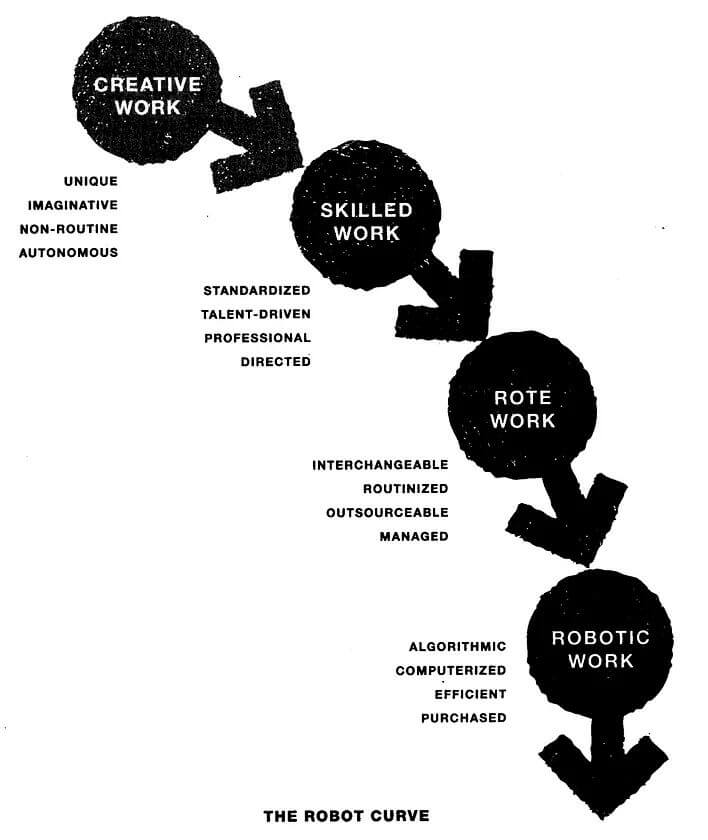
If you picture the spectrum of work in your business, from the creative and autonomous stuff at the top to the algorithmic and routine stuff at the bottom, most businesses are automating from the top down.
They’re handing off the writing, the ideas, the customer-facing communication. The work that carries their identity.
That’s backwards.
You should automate from the bottom up. Start with the routine. Start with the mechanical.
Leave the human work alone.
Principle two: the work is more valuable than the output
There’s a tempting logic to AI adoption that goes something like this: if the end result looks the same, what does it matter who or what produced it?
It matters because the process of doing the work is where the understanding develops.
Cal Newport, in his writing about craftsmanship and deep work, observed that the meaning craftsmen find in their work comes from the skill and appreciation inherent in the craft itself, not from the outcomes.
The cabinet maker doesn’t just produce a cabinet.
The act of making it sharpens their eye, deepens their understanding of materials, and builds the judgment that makes every future piece better.
Skip the making and you get a cabinet but lose the cabinet maker.
Business works the same way.
When you write your own proposals, you develop an instinct for reading a client’s situation.
When you respond to customers yourself, you start to feel when something is off before anyone tells you.
When you sit with a problem long enough to think it through, the thinking changes you.
Not just the answer.
A recent piece in Psychology Today described the progression most people are going through with AI that doesn’t get noticed: it starts with cognitive offloading, which is normal and fine.
Writing a shopping list, setting a reminder.
From there it moves to cognitive outsourcing, where you start delegating judgment. And it ends with cognitive surrender, where you’ve quietly given up on your own thinking.
The dial turns so gradually that nobody notices.
“The process of working something out changes you,” they wrote. “The product of a prompt does not.”
I’ve talked about this in a previous article, but I like Agustin Lebron’s view on this.
Think about the difference between a gym and a job.
At a gym, the point isn’t for the weight to be lifted. The point is for you to lift it.
At a job, the weight just needs to get off the ground.
Some of your work is gym work where the doing is the point. Skip it and you don’t just lose the output, you lose the muscle.

Principle three: automate what takes your time, not what requires your attention
Those are two different categories and most people treat them as one.
I looked at everything I do in my own business and put it under a microscope. I started cataloguing what takes my time but doesn’t actually need my judgment.
Research, for example. Finding articles and ideas that feed my thinking takes hours. It’s time-consuming but it’s not meaningful work in itself.
What’s meaningful is what I do with what I find.
Distilling ideas, saying it in a way that someone else can use. Connecting ideas that don’t obviously belong together.
That’s the work that’s mine.
So that’s what I chose to hand over to AI.
The research and the initial curation. The rough assembly of documents and links that gives me multiple points of view on whatever I’m working on.
I’ve already chosen what to work on and figured out my point of view before AI enters the picture.
I then read the links and documentation, choose the ones that are worth talking about that enhance the work I’m doing.
I primarily use AI to give me more time to think, not to think less.
Vitalik Buterin suggests we should focus less on AI as something separate from humans and more on tools that enhance human cognition rather than replacing it.
And there’s a practical reason for this beyond the philosophical one.
Aaron Levie of Box points out that when you automate one part of a process, you quickly discover the bottleneck somewhere else in the system. And that bottleneck is almost always the thinking.
The judgment, the taste.
The part that requires a person who has been paying attention long enough to know the difference between good and good enough.
That’s the work worth protecting.
The line is yours to draw
I’m not going to pretend there’s a clean formula for this.
The line between what to automate and what to keep human is different for every business because every business has a different relationship with its customers and a different set of things that make it worth choosing.
The easy answer is that everything public-facing should be human-touched. There’s nuance to that and it’s not always true.
But it’s a decent starting point.
What I keep coming back to is simpler than a framework.
Use AI to enhance what you value, not to replace what you find hard.
Start with what matters to you. Protect it.
Clear the mechanical work out of the way so you can do more of the real work, not less.
Jack Raines predicted that people willing to go out of their way to add a human touch will only become more valuable as more people outsource everything, and I think he’s right.
I think the businesses that draw this line with intention will end up with something the fully automated ones won’t.