AI has taken over the world, wouldn’t you say?
All major services and apps have found a way to squeeze AI into the picture so they can charge more for the same service we had before.
You see it on the news constantly. Tech companies and investors going all in on AI, taking on debt and gobbling the entire supply chain of computer parts for warehouse servers that aren’t even built yet.
The promise is that this will revolutionize efficiency and business. Gazillions of dollars. Replace all the jobs.
I see warped and incomprehensible AI videos on YouTube all the time. Images that are very clearly AI used in websites and ads.
There is nowhere you can hide where AI doesn’t exist.
13.3% of the global population uses AI as of January 2026, that’s close to one in every ten people on Earth.
But there is a quote that went viral in 2024 that made me stop and ask myself something I hadn’t thought to ask before, what should I actually be using AI for?
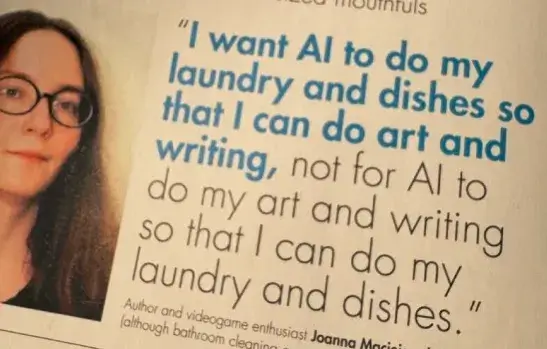
tl;dr: Use AI for the mechanical work that was never meant to be human. Protect the creative, relational, and trust-building parts of your business from automation.
But the longer answer is worth sitting with, because the line between the two is not where most people think it is.
What the AI Art Debate Tells Us About Business
There has been a lot of debate in the art world about AI. Many are against it, and with good reason.
AI has taken copyrighted material and allowed people to create something that looks like their work but with none of the credit.
But underneath the copyright argument, there is a deeper one that I think matters even more.
Art is a human expression of self.
If you take humanity out of art, you merely get something that resembles it.
When we create art, it is to make ourselves or someone else feel something. To express pieces of us that can’t be easily described or measured.
How do you describe the feeling of being in love? Or the idea of loyalty, or the concept of trust?
You don’t describe those things with efficiency. You describe them with humanity.
Most people have strong feelings about this when it comes to art.
Fewer have connected the same idea to their business, but it works exactly the same way.
When a customer reads something you wrote, they are not just reading words, they are sensing a person.
They pick up on the specific way you think, the experience behind your perspective, why you care about the thing you are writing about.
That is what makes someone feel like they found the right fit. That is what makes them stay.
We’re Using AI for the Wrong Parts of Our Business
Because business is so complex, we spend the majority of our time dealing with fires. Packaging problems, employee retention, and everything else that demands attention right now.
We find ourselves working in the systems we created rather than the parts that take a really long time, like building relationships, improving our products/ services, or generating ideas for marketing.
When AI came along, everyone seems to have started using it for the parts of the business they had been neglecting. And they found out it somewhat worked.
“Somewhat worked” is doing a lot of heavy lifting in that sentence…
The parts we neglect in business are usually the hard to measure things.
Writing that connects, outreach that feels personal, showing up consistently in ways that build trust over time.
Those things take forever to compound and they don’t fit neatly into a spreadsheet.
The parts we protect and optimize are usually systems. Processes, response times, conversion rates.
The stuff that shows up in a dashboard or in reports.
The slow, human, relational work went to AI. The mechanical work we could have automated years ago stayed in our hands. Meanwhile, AI will eventually do that mechanical work faster and cheaper than any of us ever could.
So we are protecting exactly the things we should be letting go of, and letting go of exactly the things we should be protecting.
And when every business is using the same AI models with the same prompts, everyone starts to sound the same.
When you let AI handle your blogs, your chat responses, etc. You lose the ability to connect with someone. They can’t get a feel for who you are and what you care about.
So they have to make the decision based on what you put in front of them, most often price and features. Which means you are always in competition against others for the cheapest price with the most features, and that can only take you so far.
A 2026 report from Adobe found that while 93% of marketing leaders believe AI helps them understand customer needs, only 53% of consumers actually feel that brands are successfully predicting what they want.
That gap is telling us something.
The Gym and the Job
Author Agustin Lebron said something about AI that I think makes things very clear.
“A simple way to figure out whether to use AI at work, or in life, is to think about the difference between a gym and a job.
At a gym, the point isn’t for the weight to be lifted, but for you to lift the weight. At a mere job, however, the point is for the weight to be lifted.”
Use AI for the jobs in your life. Don’t use AI for the gyms in your life.
In your business, the jobs are the things that needed to get done but were never really about you. Research, data pulls, formatting reports, scheduling. The overhead.
The mechanical work that always felt like it was getting in the way of the real work.
Hand those off.
The gym is the creative work. The relationship building.
The response to a client who is confused or frustrated and needs to feel heard. The article that shares your actual thinking, and the decision that requires judgment and context that only you have.
I think of it like a scientist in a lab.
AI is the instrument that collects the data, organizes it, runs the numbers. The scientist is the one who looks at all of that and decides what it means. The meaning is the human part. The interpretation.
The taste.
Rick Rubin talks about this idea of taste in his book, The Creative Act. The ability to look at something and know whether it is right or not. Whether it needs more or less.
To make a judgment call that no dataset or algorithm can replicate.
That kind of knowing doesn’t come from training data. It comes from years of living, paying attention, caring about something deeply enough that your instincts become reliable.
Taste is what makes your business yours.
It is the reason two businesses can offer the same service and feel completely different. AI can do a lot of impressive things, but it cannot replicate your taste.
Most businesses I see are using AI backwards right now.
Nobody Told You They Stopped Trusting You
Think about what it looks like to approach a business for the first time.
You land on their website and the images look a little too perfect, a little too generic. The kind you have seen on a hundred other websites that week.
The copy reads smoothly but says nothing specific about anything.
You send an email or a message and you get a response within seconds that somehow answers your question without actually engaging with it.
Everything is functional and everything is fast. But you know you’re not going to remember this company. Something is off that you can’t really name. But you feel it.
Research from Gartner found that 53% of customers would consider switching to a competitor if they found out a company was using AI for customer service.
A separate study found that when people call a business and are connected to AI, 29% hang up immediately.
Almost one in three people gone before the conversation even begins.
We saw a version of this play out publicly with Air Canada.
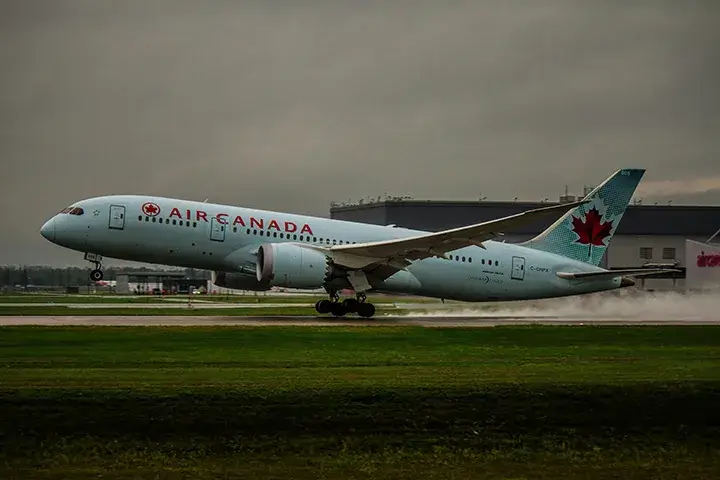
In 2022, a customer named Jake Moffatt visited the airline’s website to book a last-minute flight to Toronto after his grandmother passed away.
He asked the chatbot about bereavement fares, and the chatbot told him he could book a full-price ticket and apply for a partial refund within 90 days.
Moffatt followed that advice, flew to the funeral, and then applied for the refund.
Air Canada denied it.
The chatbot had given him the wrong information. The actual policy stated that bereavement fares had to be requested before travel, not after.
Air Canada’s response was to argue that the chatbot was essentially a separate entity and the airline could not be held responsible for what it said. The British Columbia Civil Resolution Tribunal disagreed and ordered the airline to pay damages.
That story made international headlines. But what sticks with me is the fact that Moffatt was grieving.
He went to the website looking for help during one of the worst moments of his life and instead of a person that could sympathize and understand where he was coming from, he got a machine that gave him the wrong answer.
Then the company tried to blame the machine.
That is what the erosion of trust looks like when it makes the news. But most of the time you don’t see this erosion that publicly.
Most of the time, nobody sends you a message saying “I have lost trust in your business.”
Most people won’t leave a review about it. Most won’t give you the chance to fix it.
They just quietly lower their expectations. They decide this is probably just how this business operates now, and move on the second they find an alternative.
You lose them without a single signal that they were leaving.
That cost does not show up on any dashboard, but it accumulates. And by the time you notice it in your numbers, the trust has been gone for a long time.
Why Business Is Relationships Before It Is Transactions
All of this comes back to something pretty simple.
Always has been.
The money follows the trust, the trust follows the human connection, and a human connection requires two people to actually show up.
Think about any relationship worth having. A client, a colleague, a partner, a friend. It works when both people are in the room. Both doing the work, and both with something at stake.
Automating your side of the relationship doesn’t make the relationship more efficient, it ends it.
What you’re left with is something that looks like a relationship from a distance but functions like a transaction wearing a costume.
People can tell.
They may not articulate exactly why something feels different. But over time, that feeling is the difference between a customer who stays and one who quietly finds someone else.
If you want all of the benefit with none of the risk and none of the work, that’s not a relationship. It’s not even how business works.
So What Is Actually Worth Keeping Human?
I want to be clear that I’m not arguing against AI. This is a technology that will revolutionize the world like the printing press, the phone, or the internet.
What I’m arguing is where the AI revolution should go towards, and it shouldn’t be towards the most human parts of our businesses.
Let AI handle the jobs.
The research, the first drafts of templated things, the data work, the scheduling, the mechanical overhead that was always in the way of the real work.
Keep the gym work. The showcasing of your expertise in a way that only you can. The creative parts like the writing, the feeling you want someone to feel when they encounter your business, the taste to make decisions that align with you.
How you choose to build relationships with other people.
That’s worth figuring out how to keep human.
Should you use AI in the first place? I believe it has its place. But for me I think the better question is what are you willing to hand off and what are you willing to protect in your business?